Which Company Appears on Your Statement
Third-party payment processors often appear on card statements instead of the brand name, which causes unnecessary disputes and complic
2 September 2026MemoHive
MemoHive® is a daily capsule formula designed to support memory, focus, mental clarity, and everyday cognitive wellness. Each serving provides 1,030 mg of five listed ingredients—Branched-Chain Amino Acids (BCAAs), Bacopa Monnieri, Rhodiola Rosea, L-Theanine, and Panax Ginseng—with each ingredient clearly identified on the label.
MemoHive® is a daily capsule designed to support memory, focus, mental clarity, and everyday cognitive wellness. Two capsules give 1,030 mg: BCAA 540 mg, bacopa 200, rhodiola 100, L-theanine 100, ginseng 90. The BCAA is sports nutrition with no cognition evidence. Of the rest, only the L-theanine reaches its studied range. $49–$79 a bottle, 60-day guarantee.
Reviewed by Dr. Renata Alvarez, PharmD, BCGP · every amount checked against the published research
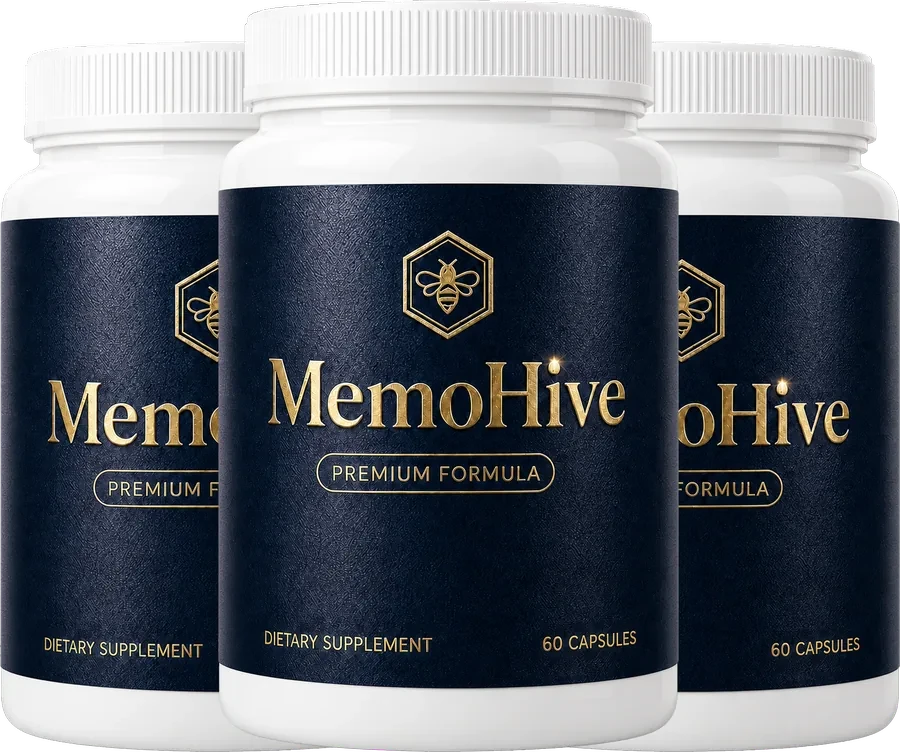
| Product | MemoHive — memory & focus capsules |
|---|---|
| Format | 60 capsules per bottle |
| Serving | 2 capsules once daily, before a meal |
| Per serving | 1,030 mg, fully disclosed |
| Ingredients | 5, no proprietary blend |
| Largest ingredient | BCAA 540 mg (52%) |
| Aimed at the brain | 490 mg across 4 ingredients |
| At studied dose | 1 of 4 (L-theanine) |
| Price | $49–$79 per bottle |
| Guarantee | 60 days |
| Our rating | 3.2 / 5 |
New or worsening memory problems deserve a doctor's assessment before a supplement. Thyroid disease, vitamin B12 deficiency, depression, poor sleep, alcohol and a long list of common medications all affect memory — and most are treatable once identified. MemoHive is not a treatment for dementia or Alzheimer's disease, and the brand says so too.
The headline number is real and the label is honest. The question nobody selling this product asks is what that total is made of — so here it is, split by ingredient.
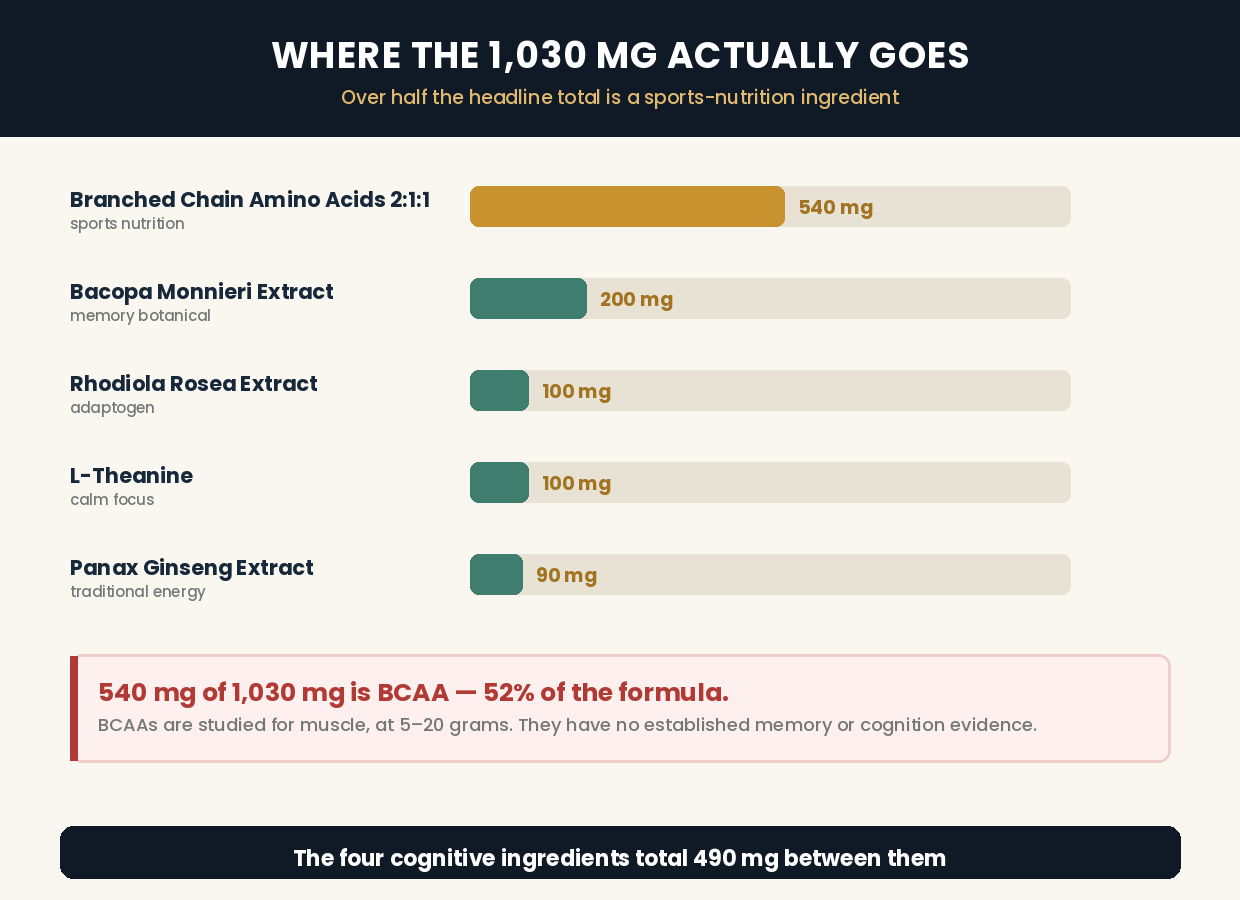
540 mg of the 1,030 mg — 52% — is branched chain amino acids, a sports-nutrition ingredient with no established memory or cognition evidence, studied for muscle at 5–20 grams. The four ingredients actually aimed at the brain total 490 mg between them.
Every figure on this page comes from the brand's own published Supplement Facts panel. Most products in this category make an analysis like this impossible by hiding everything inside a proprietary blend. MemoHive does not, and that is a real mark in its favour — it is the reason this review scores higher than most we publish.
| Ingredient | On the label | What the research used |
|---|---|---|
| Branched Chain Amino Acids 2:1:1 (L-leucine, L-isoleucine, L-valine) | 540 mg | 5–20 g for muscle; no established cognition evidence |
| Bacopa Monnieri Extract (Brahmi) | 200 mg | 300–450 mg, 12 weeks; bacoside standardisation not stated |
| Rhodiola Rosea Extract (golden root, 3% salidroside) | 100 mg | 200–600 mg daily; trials use a different standardisation |
| L-Theanine (from tea leaves) | 100 mg | 100–400 mg; at the bottom of the range |
| Panax Ginseng Extract (Asian ginseng) | 90 mg | 200–400 mg; no ginsenoside standardisation stated |
| Total per serving | 1030 mg | of which 490 mg is aimed at the brain |
Disclosure tells you what you are taking. It does not tell you whether it is enough. Here is each brain ingredient against the dose range its own research used.
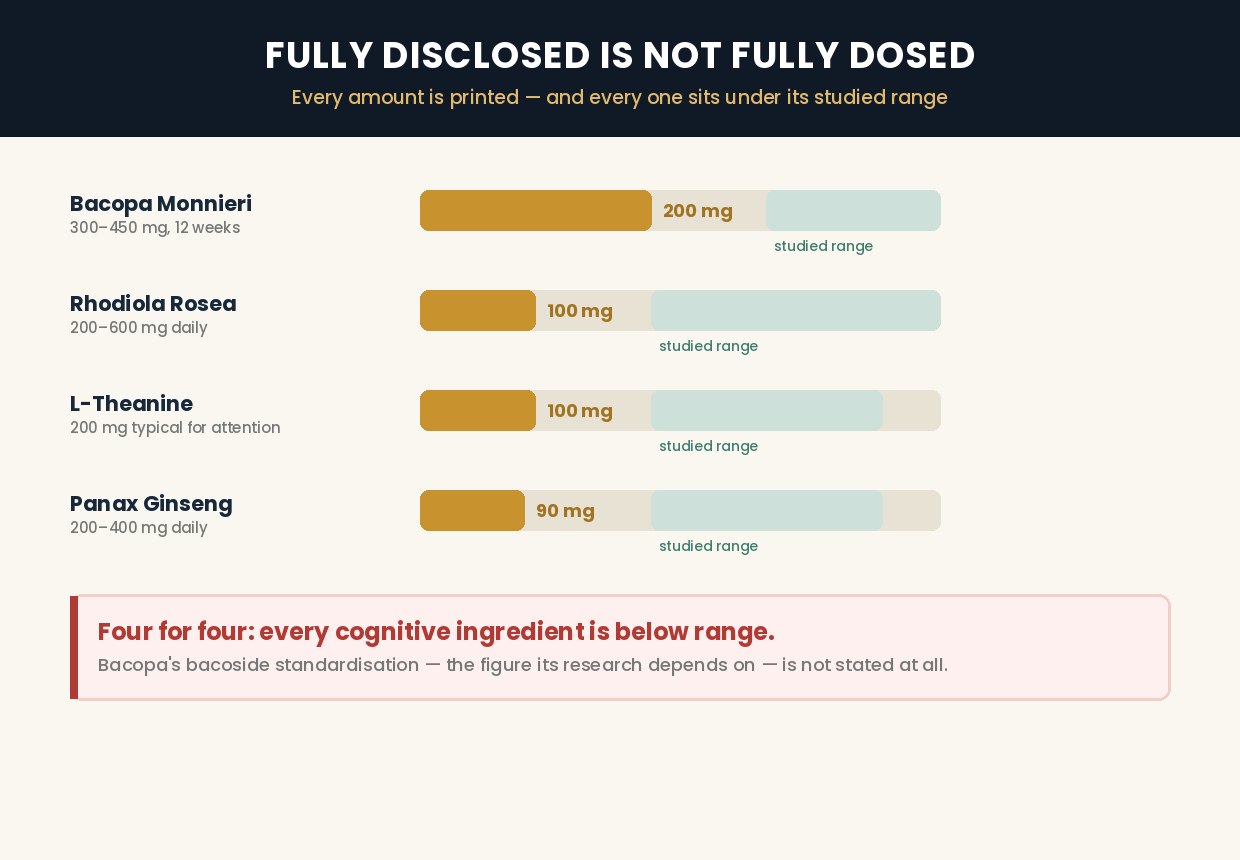
Bacopa 200 mg against 300–450 mg used in 12-week trials — and no bacoside standardisation printed, which is the figure its whole research base depends on.
Rhodiola 100 mg against 200–600 mg, at a different standardisation from the extract the main trials used.
Panax ginseng 90 mg against 200–400 mg, with no ginsenoside figure stated.
L-theanine 100 mg is the exception: at the bottom of its studied 100–400 mg range rather than below it. Full detail on the ingredients page.
Each claim is taken from MemoHive's own packaging or the pages selling it, and judged against one thing: whether the printed amount reaches the dose the research actually used.
Supported. This is true, checkable and genuinely uncommon. Five ingredients, five amounts, no proprietary blend. The brand deserves real credit for it, and this review is kinder than most because of it.
Partly. The total is real, but 540 mg of it — 52% — is BCAA, a sports ingredient with no cognition evidence. The four ingredients actually aimed at the brain total 490 mg.
Partly. Bacopa is a credible memory ingredient, but 200 mg sits below the 300–450 mg used in trials, and the bacoside standardisation its activity depends on is not stated.
Partly. L-theanine at 100 mg is at the low end of its studied range rather than below it — the best-dosed ingredient here, though the research often pairs it with caffeine.
Not supported. Rhodiola is studied at 200–600 mg; this is 100 mg, and at a different standardisation (3% salidroside) from the extract used in the main trials.
Not supported. Panax ginseng is studied at 200–400 mg of a standardised extract. At 90 mg, with no ginsenoside figure stated, this is the weakest inclusion in the formula.
Not supported. This claim appears on the brand's own how-it-works artwork and belongs to the BCAA, not to a memory product. BCAA muscle research uses 5–20 g — roughly ten to forty times the amount here.
Supported. Two capsules once a day, one bottle a month. As a habit it is about as easy as this category gets, and consistency is what any supplement needs.
Five ingredients, five printed amounts, no proprietary blend, and the full panel published for anyone to read before ordering. In a category where hiding numbers is the norm, this is a meaningful difference and it should be said plainly.
It is also what lets you check the formula yourself — including the parts that do not hold up.
Over half the total is a sports amino acid with no cognition evidence. Of the four brain ingredients, three sit below their studied ranges and only the L-theanine reaches the bottom of its own.
An honest label showing small doses is better than a dishonest one. It is not the same as an effective formula.
MemoHive is a memory and focus support capsule — 60 capsules per bottle, two capsules once daily, 30 servings. Each serving gives 1,030 mg across five fully disclosed ingredients. It suits someone who wants a transparent, simple daily supplement; it does not suit anyone expecting studied doses of the cognitive ingredients.
Read as what it is — a modest, honestly labelled daily nootropic blend — MemoHive suits an adult who wants a simple two-capsule routine and values being able to see exactly what they are taking. The ingredient choices are conventional and sensible, and the transparency is real.
Read as the 1,030 mg cognitive formula it is sold as, it does not hold up: more than half that total is a sports ingredient, and the brain actives are mostly under-dosed. Full detail on what MemoHive is, or see how MemoHive works.
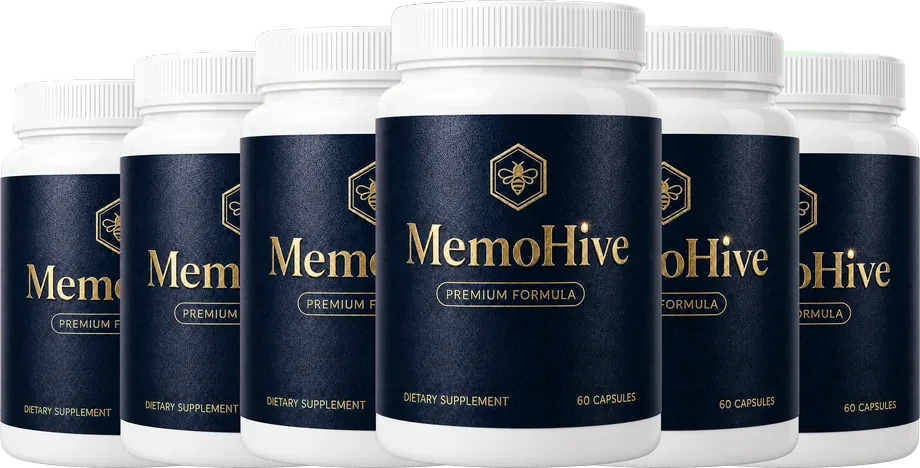
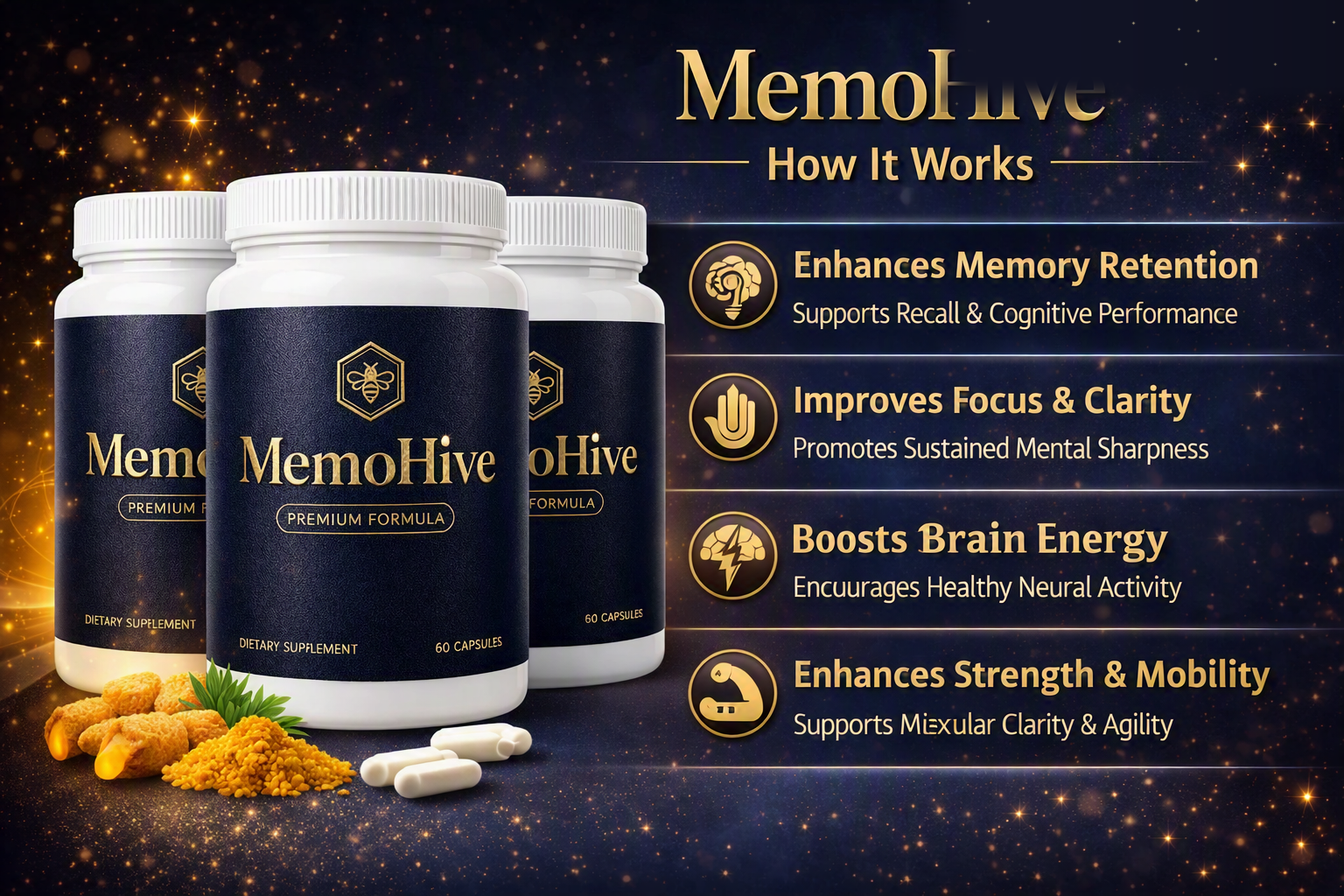
Supplied brand artwork, used as provided with only the “Made with AI” badge removed. Note its fourth panel — “Enhances Strength & Mobility” — in a memory product. That claim belongs to the BCAA, and it is the clearest sign of where this formula's largest ingredient really comes from.
Through four conventional nootropic pathways and one that does not belong. Bacopa is associated with memory consolidation over about 12 weeks, L-theanine with calm attention the same day, rhodiola with mental fatigue, ginseng with alertness. The BCAA supplies amino acids with no established cognitive route at all.
The stated direction is two capsules with an 8 oz glass of water, 20 to 30 minutes before a meal. That is 1,030 mg of total actives in one daily serving, 30 servings per bottle.
540 mg of BCAA is the biggest single component. It is absorbed like any amino acid and used throughout the body — but it has no established route to better memory.
Bacopa's trials run 12 weeks before measuring an effect. Whatever it contributes builds gradually; nothing about this ingredient is a same-day experience.
These three are associated with same-day effects on alertness, calm and fatigue. At 100, 100 and 90 mg respectively, only the L-theanine is inside its studied range.
What each one is, what the research used, and how far the label sits from it. Full context on the MemoHive ingredients page.
well below, or wrong category
52% of the formula · studied at 5–20 g daily, for muscle endpoints
Why is a sports supplement the biggest ingredient in a memory formula?
This is the finding that matters most. BCAAs are the single largest component at 540 mg — over half the headline 1,030 mg — and they are a sports-nutrition ingredient with no established memory or cognition evidence.
below studied range
19% of the formula · studied at 300–450 mg daily for 12 weeks
Is 200 mg of bacopa enough to do anything?
It is the most credible ingredient here for memory — and it sits below the amount the trials used, with the one specification that matters left off the label.
below studied range
10% of the formula · studied at 200–600 mg daily
Does 100 mg of rhodiola help with fatigue or stress?
Rhodiola has real research for mental fatigue, but at two to six times this amount — and the standardisation quoted is not the one the trials used.
below studied range
10% of the formula · studied at 100–400 mg; 200 mg typical for attention
Is 100 mg of L-theanine a working dose?
This is the closest the formula comes to a studied amount — it is at the bottom of the range rather than under it, which is a real if modest distinction.
well below, or wrong category
9% of the formula · studied at 200–400 mg daily of standardised extract
What is 90 mg of ginseng doing here?
It is the smallest ingredient and the furthest below its studied range — closer to a label mention than a working dose.
Bacopa's trials run 12 weeks, which is three bottles. The guarantee runs 60 days, so three bottles is the pack that covers a fair trial while keeping the refund decision at day 50 sensible.
See Current MemoHive PricingOfficial website checkout · 60-day guarantee · confirm the terms before paying
MemoHive already does the hard part — printing the numbers. These are the changes that would make those numbers match the evidence:
Supported: full label transparency, a simple two-capsule routine, and genuinely well-chosen ingredients. Partly: calm focus from L-theanine, and memory support from bacopa if the extract is well standardised. Not supported: the BCAA foundation as a cognitive benefit, and the strength-and-mobility claim on the brand's own artwork.
These are supportive wellness statements for healthy adults, not promised outcomes. Each carries the same ruling used in the verdict matrix, so you can see which claims the printed amounts actually back. More detail on the MemoHive benefits page.
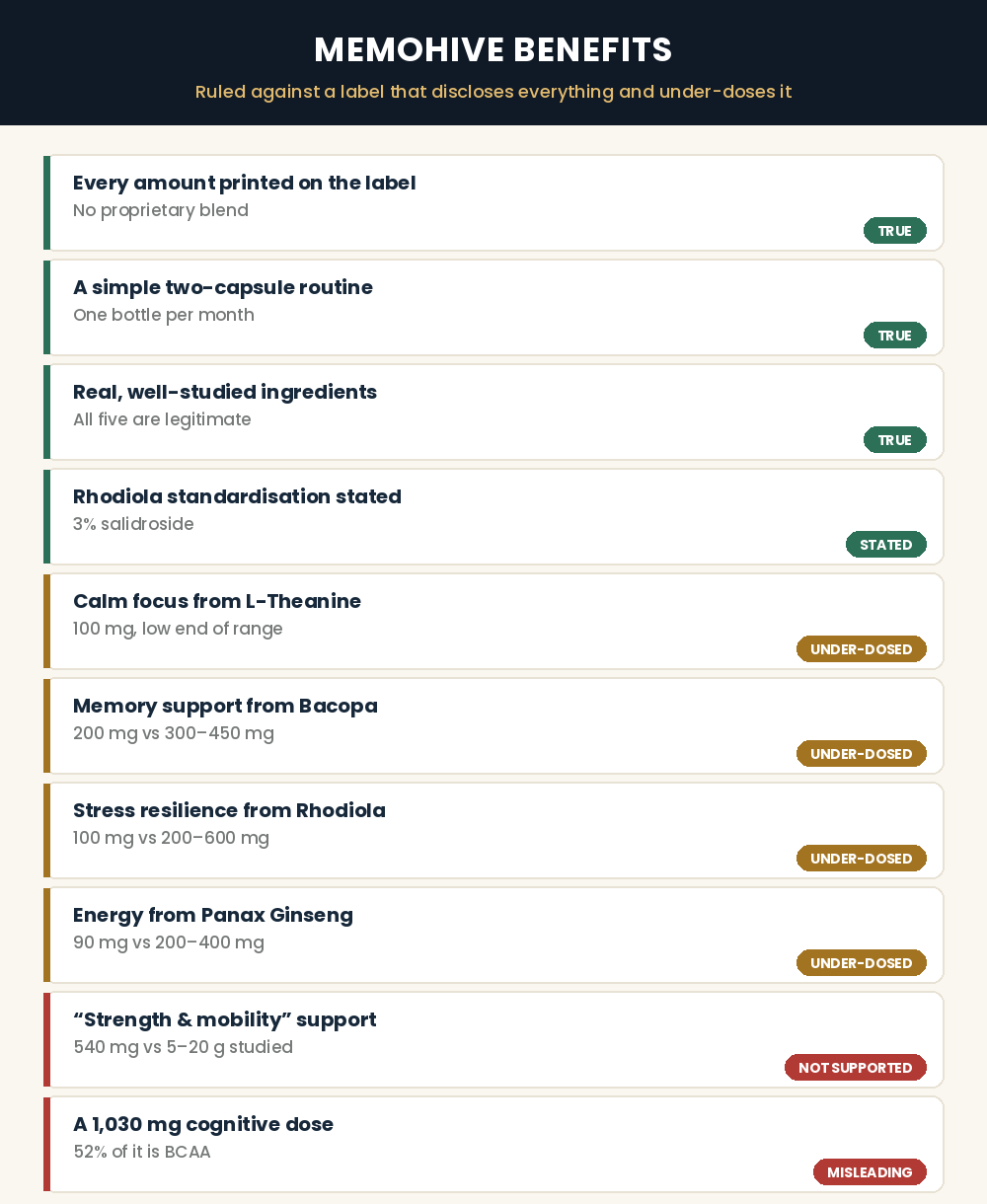
Every one of the five ingredients carries its own printed amount, with no proprietary blend anywhere. In a category built on hiding numbers, this is a genuine and rare strength, and it is what makes an honest analysis of this product possible at all.
Two capsules once daily with water, one bottle per month. No splitting doses, no multi-pill protocol, nothing to time around. Easy routines get taken; complicated ones get abandoned.
Bacopa, rhodiola, L-theanine and ginseng are all legitimate, widely studied inclusions in cognitive formulas. Nothing here is exotic filler or a novelty compound.
At 100 mg this is the best-dosed ingredient in the formula, sitting at the bottom of the studied 100–400 mg range. Expect something modest rather than nothing — though the research most often pairs it with caffeine, which is not included.
Bacopa has the strongest memory research of anything here, but at 200 mg against the 300–450 mg used in trials, and with no bacoside standardisation printed, the amount cannot be matched to the evidence.
Rhodiola and ginseng contribute plant compounds at small amounts. A reasonable dietary addition, not a therapeutic dose of either.
The 540 mg BCAA base is presented as the formula's foundation. For a memory product it is the weakest part of the label: no cognition evidence, and a tenth to a fortieth of the amount used in its own sports research.
This claim sits on the brand's own artwork and cannot be delivered. BCAA muscle studies use 5–20 g daily; 540 mg is not in that territory, and it does not belong in a memory formula's benefit list either.
Thyroid disease, B12 deficiency, depression, sleep apnoea and many common medications all affect memory, and most are treatable once found. Get that ruled out before you spend anything on a supplement.
Read as a modest, transparent daily blend, MemoHive is reasonable. These steps keep it that way and keep you safe.
New or worsening memory problems deserve a doctor's assessment. Thyroid disease, B12 deficiency, depression, sleep apnoea and a long list of medications all affect memory, and most are treatable. No supplement substitutes for finding out.
Unusually for this category, you can check every amount before you buy. Do it, and compare each one with the studied range on this page rather than with the headline total.
Twenty to thirty minutes before eating, with a full glass of water, at the same time each day. Bacopa in particular is hard on an empty stomach for some people.
If you are trialling this for memory, the relevant ingredient needs about 12 weeks. That is longer than the guarantee window, which is worth planning around.
Ginseng interacts with warfarin and diabetes medication; rhodiola with antidepressants; bacopa with thyroid medication and sedatives. A pharmacist can clear all of it in minutes.
Rhodiola and ginseng can both be stimulating. A morning dose avoids the most common complaint people report with formulas like this.
Names forgotten per week, times you lost your keys, and a focus score out of ten. Recount at weeks four, eight and twelve — memory is exactly the faculty you cannot trust to compare itself with last month.
The guarantee is 60 days. A six-bottle order is 180 days of product, so most of it falls outside the window whatever you decide.
Two bottles at $79 each ($158 plus $9.99 shipping), three at $69 each ($207, free shipping) or six at $49 each ($294, free shipping). The MemoHive discount is applied by bundle size rather than a coupon code, and there is no single-bottle option.

Worth two seconds of arithmetic before you accept a saving. The two-bottle pack is shown as reduced from $258, which is $129 a bottle. The three-bottle pack is reduced from $237 and the six-bottle from $474 — both of which are $79 a bottle. The same product cannot have a “regular” price of $129 and $79 at the same time. Ignore the crossed-out figures entirely and compare the real totals, which are $158 (plus $9.99 shipping), $207 and $294.
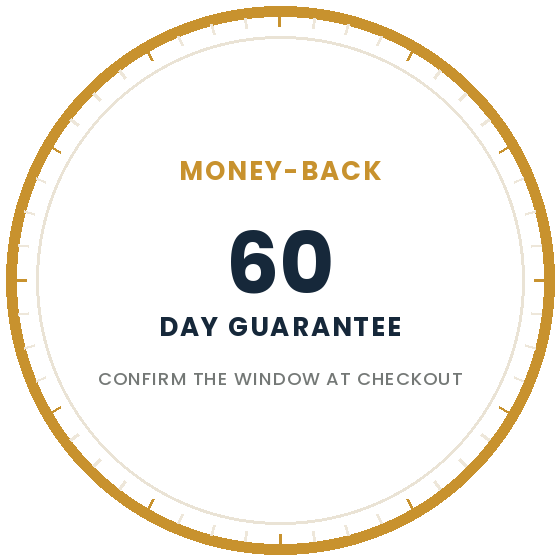
Sixty days from purchase, per both selling pages. Note that the six-bottle bundle is 180 days of product, and that bacopa's own trials run 12 weeks — slightly longer than the window you have to decide in.
Both selling pages state a 60-day money-back guarantee, no questions asked. As a policy that is reasonable and we have no criticism of the wording.
There are two structural awkwardnesses. The heavily promoted six-bottle bundle is a 180-day supply, so four of those six months sit outside any refund window. And bacopa — the one ingredient here with a real memory research base — is measured in trials at 12 weeks, which is longer than the guarantee itself. Screenshot the terms with the date, and set a reminder for day 50.
Check the Guarantee Terms

Badges describe manufacturing procedures and a stated policy. They are not evidence a formula works, and they say nothing about whether the amounts inside it match the research. No dietary supplement is FDA-approved — an FDA-registered facility means the manufacturing site is on file with the agency, which is a paperwork fact rather than an endorsement. To their credit, both pages selling MemoHive state this distinction correctly rather than claiming approval.
One selling page advertises a 4.8/5 average across 940+ reviews, none of which can be independently audited. Our own assessment is on the MemoHive review page.

"I bought it because the label actually lists the amounts, which almost nothing else does. Whether 200 mg of bacopa is enough is a question I only thought to ask later."

"Easy routine, two capsules before breakfast. After two months I couldn't point to a clear change. My GP checked my B12 and thyroid, which I should have done first."

"Took it with warfarin without checking. My pharmacist told me the ginseng was a problem. That should be on the box, not buried in a FAQ."
The most likely effect is mild digestive upset from the bacopa, which is why the directions say to take it before a meal. The real cautions are interactions: panax ginseng with warfarin and diabetes medication, rhodiola with antidepressants, bacopa with thyroid medication and sedatives. Above all, memory changes need a doctor.
This matters more than anything else on the page. New or worsening forgetfulness can come from thyroid disease, B12 deficiency, depression, poor sleep, alcohol or medication side effects — most of which are treatable when identified. It can also be an early sign of something that needs proper assessment. A supplement is not a substitute for finding out, and MemoHive is not a treatment for dementia or Alzheimer's disease.
Ginseng can reduce the effect of warfarin and may affect blood sugar, which matters if you take diabetes medication. It can also add to the effect of stimulants. Tell your anticoagulation clinic or pharmacist before starting.
Rhodiola can be stimulating and is best avoided late in the day. Caution is advised alongside antidepressants, and in bipolar disorder, because of possible additive effects.
Bacopa's most common side effect is digestive upset, particularly on an empty stomach, which is one reason the directions say to take the capsules before a meal rather than instead of one. It may also interact with thyroid medication and sedatives.
At 540 mg they are unlikely to trouble most people, but anyone with maple syrup urine disease must avoid branched chain amino acids entirely, and people with liver or kidney disease should ask before adding an amino-acid supplement.
The brand advises consulting a physician, and that is the right advice: several of these botanicals lack safety data in pregnancy and breastfeeding, and none of them has been studied in children.
Short, specific answers to what buyers search before ordering from the MemoHive official website. Every one traceable to the published panel, a study, or a stated policy.
Check Price & AvailabilityMemoHive is a memory and focus support capsule: 60 capsules per bottle, two capsules once daily, 30 servings. Each serving provides 1,030 mg across five fully disclosed ingredients — BCAA 2:1:1 540 mg, bacopa monnieri 200 mg, rhodiola rosea 100 mg, L-theanine 100 mg and panax ginseng 90 mg.
No, and that deserves saying clearly. Every ingredient carries its own printed amount with no proprietary blend, which is genuinely rare in this category. The question this site asks is a different one: whether those disclosed amounts reach the doses the research used.
That is the formula's central oddity. At 540 mg, BCAAs are 52% of the headline 1,030 mg, yet they are a sports-nutrition ingredient with no established memory or cognition evidence, studied for muscle at 5–20 grams. The four ingredients actually aimed at the brain total 490 mg between them.
It is below the 300–450 mg used in the trials, which typically run 12 weeks. The larger problem is that no bacoside standardisation is printed, and bacopa's activity is attributed to its bacoside content — so the 200 mg cannot be compared with the studied material.
L-theanine at 100 mg sits at the bottom of its studied 100–400 mg range. Rhodiola at 100 mg is below the 200–600 mg used in research, and panax ginseng at 90 mg is under half the low end of its 200–400 mg range.
There is no clinical trial of the finished formula, and neither page selling it claims otherwise. Based on the amounts, the most plausible contributor is the L-theanine, with bacopa a possibility over 12 weeks if the extract is well standardised. The BCAA is not doing anything for your memory.
Two capsules once daily with an 8 oz glass of water, 20 to 30 minutes before a meal. Taking it before food matters: bacopa causes stomach upset in some people on an empty stomach.
The most likely is mild digestive upset from the bacopa. Rhodiola and ginseng can be stimulating and disturb sleep if taken late. The real cautions are interactions: ginseng with warfarin and diabetes medication, rhodiola with antidepressants, bacopa with thyroid medication.
No, and the brand says so too. It is a dietary supplement, not a treatment for any diagnosed condition. New or worsening memory problems need a doctor's assessment, because several common causes are treatable.
Two bottles at $79 each ($158 plus $9.99 shipping), three at $69 each ($207, free shipping), or six at $49 each ($294, free shipping). Note the seller's own reference prices are inconsistent: the two-bottle anchor implies $129 a bottle while the three and six-bottle anchors imply $79.
Both selling pages state 60 days, no questions asked. The six-bottle bundle they promote hardest is a 180-day supply, so most of it sits outside that window. Decide by day 50.
If anything here works for memory it is the bacopa, and its trials measure at 12 weeks. That is longer than the 60-day guarantee, which is an awkward but important thing to plan around.
Through the official checkout, so the stated guarantee attaches to your order. Two near-identical sites sell it with the same formula and pricing; a third blocks automated access, so we could not read it. Screenshot the terms on whichever page you use.
Our rating is 3.2 out of 5 — higher than most in this category, because the label is honest. But four of its five ingredients sit below their studied ranges and the largest is a sports ingredient in a brain product. You are paying a premium price for a transparent label rather than for studied doses.
Third-party payment processors often appear on card statements instead of the brand name, which causes unnecessary disputes and complic
Six specific, achievable changes — and the hardest one is already done.
Higher consumption of ultra-processed food is associated with poorer cognitive outcomes in observational research, though causation is
The tip-of-the-tongue state — knowing you know a word but being unable to retrieve it — is a normal retrieval failure, not evidence the
Buying one well-standardised ingredient at its studied dose is often cheaper and always easier to evaluate than a multi-ingredient blen
Rash, swelling, breathing difficulty, severe digestive symptoms or unusual heart rhythms after starting a supplement warrant stopping i
You now have the full split of the 1,030 mg, each amount against the dose its research used, the standardisations that are missing, the interaction cautions, the inconsistent reference prices and the guarantee-versus-supply gap. That is more than either page selling it will give you — and it was only possible because this brand prints its numbers.
If a transparent, modest daily blend is what you want — judged as that, and after a doctor has looked at any memory change — three bottles covers the 12 weeks bacopa's research uses. From $49 per bottle · free US shipping on 3 and 6 · 60-day money-back guarantee.
Claim Your MemoHive Discount